
Publishing Admin vs PRO vs Music Distributor: Complete 2026 Guide for Indie Artists
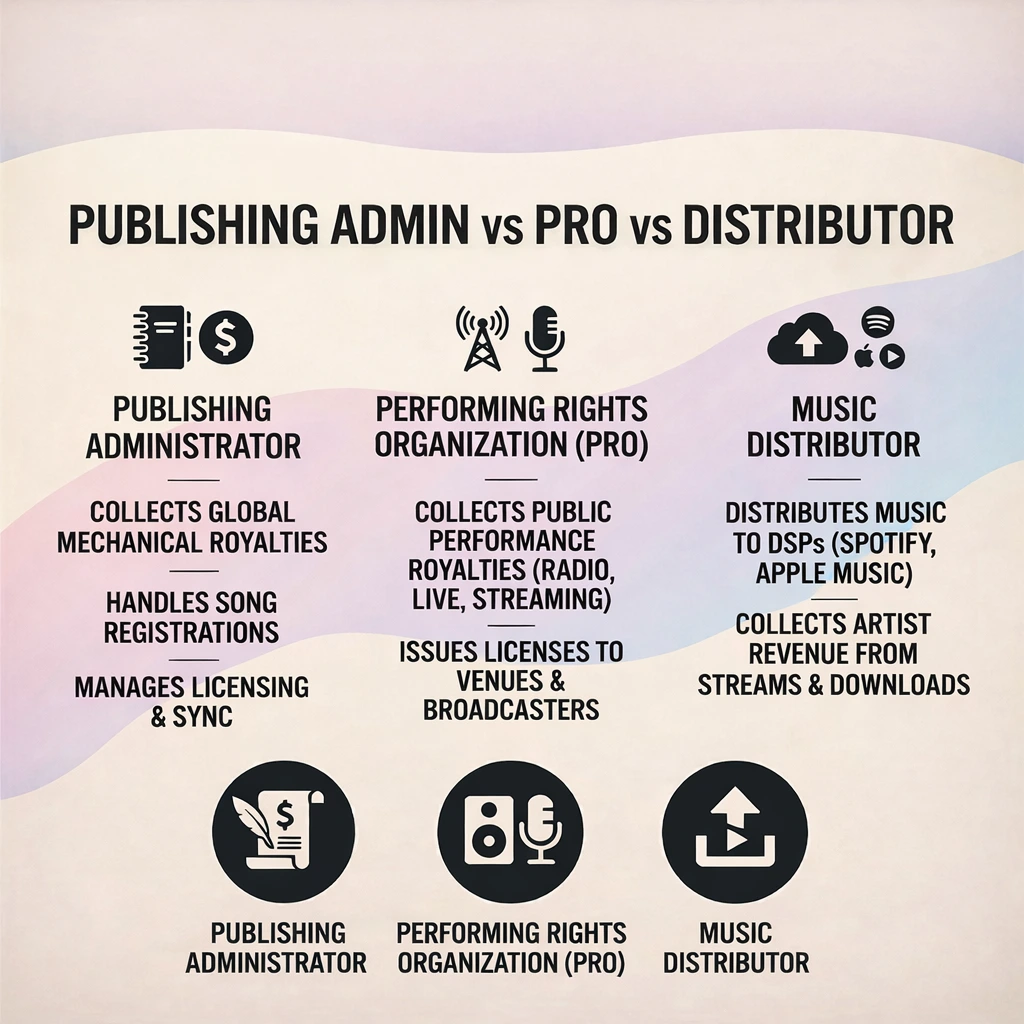
Quick Answer: A music distributor handles your master recordings and gets your tracks on Spotify and Apple Music. A PRO collects performance royalties for public plays of your songs. A publishing administrator manages the global business side of your compositions — registering everywhere, collecting mechanicals, sync, and more — without taking ownership. Most indie artists need pieces of all three, but thanks to direct MLC registration you can often skip the publishing admin for US mechanicals and still collect 80-90% of what you’re owed.
If you’ve ever uploaded a song, joined ASCAP or BMI, and then wondered why you’re still missing money, you’re not alone. The lines between publishing admin vs PRO vs music distributor blur fast, especially in 2026 when streaming dominates but collection systems remain split between master and composition copyrights. I’ve helped over 200 independent artists sort this out, and the biggest mistake I see is assuming one service covers everything. This guide fixes that with clear facts, real numbers, and a decision framework built for today’s reality.
Why Publishing Admin vs PRO vs Distributor Still Confuses Indie Artists in 2026
The music industry throws a lot of jargon at you, and the split between master and composition rights makes it worse. Streaming now makes up roughly 70% of global recorded music revenue according to the latest IFPI reports, yet royalties still flow through completely different pipelines. One wrong choice and you could leave thousands on the table — or waste money on services you don’t actually need.
I get the frustration. Artists message me every week saying things like “My distributor said they handle publishing” or “I joined BMI so I thought I was good.” The truth is simpler than the hype: these three services solve different problems. Understanding publishing admin vs PRO vs music distributor means you stop guessing and start collecting.
The Complete Music Royalty Ecosystem Explained
Your song has two copyrights. The master (the actual recording) goes to your distributor. The composition (the song itself — melody, lyrics, chords) goes to PROs for performance royalties and to the MLC or a publishing admin for mechanical royalties. Sync licensing and international collections add extra layers. Once you see the full flow, the confusion disappears.
What Is a Music Distributor (and What It Actually Handles)
A music distributor is the bridge between your finished track and the streaming platforms. They deliver the master recording, ISRC codes, artwork, and metadata so your song can actually appear on playlists and get paid when people hit play.
What they handle well: master royalties from streams, downloads, and sales. They keep 100% of those royalties on most plans (DistroKid being the classic example). They also give you tools for pre-saves, release scheduling, and basic analytics.
What they don’t touch: anything on the composition side. No PRO registration, no mechanical collection outside the master split, and no global publishing admin work. That’s why so many artists think they’re “covered” after distribution — until the first royalty statement shows missing composition money.
In 2026 the top players have added some publishing-lite features, but they still aren’t true publishing administrators. If your distributor offers an optional admin add-on, weigh the convenience against the commission before you click accept.
What Is a PRO (Performing Rights Organization)?
A PRO — whether ASCAP, BMI, SESAC in the US or PRS, SOCAN, or their international equivalents — exists to collect performance royalties every time your composition gets played publicly. Radio, live venues, streaming services, bars, gyms, even TikTok background music — all of it triggers a performance royalty.
You register your songs once (or per co-write), they issue licenses to businesses, track the plays through their data partners, and cut you checks for the writer’s share (and publisher’s share if you claim it). It’s usually low or no upfront cost, which makes PROs the easiest first step for most songwriters.
Here’s the catch most guides skip: PROs only handle performance. They do not collect mechanical royalties from streams or downloads, and they don’t chase international societies or sync deals for you. That gap is exactly why publishing administrators exist.
What Exactly Is a Publishing Administrator (and Why It’s Not a Full Publisher)?
A publishing administrator is a service that handles the boring-but-profitable admin work for your composition catalog without ever owning any rights. Think of them as your global royalty collection agency.
They register your songs with 60+ collection societies worldwide, the MLC in the US, YouTube’s composition side, and dozens of mechanical rights organizations. They track down every mechanical royalty (the money paid when your song is streamed or downloaded), micro-sync deals, and even live performance data from setlists. In return they take a commission — usually 15-20% of what they collect — plus sometimes a small one-time setup fee.
Unlike a traditional publisher, they don’t take 50% ownership or creative control. You keep 100% of your copyrights and simply pay them for doing the paperwork and chasing the money. In 2026 this model is more popular than ever because direct MLC registration made the US piece easier, but the rest of the world still needs help.
Performance vs Mechanical vs Sync Royalties: The Crucial Differences
Understanding the royalty types is the fastest way to stop overpaying or under-collecting.
| Royalty Type | Who Pays It | Which Copyright | 2026 Share of Revenue (approx.) | Best Collected By |
|---|---|---|---|---|
| Performance | Radio, venues, DSPs | Composition | 30-45% | PRO + publishing admin |
| Mechanical | Streaming platforms | Composition | 40-50% (fastest growing) | MLC (US) + publishing admin |
| Sync | TV, ads, films, TikTok | Composition | 10-20% (highest per-use value) | Publishing admin or direct |
| Master Streaming | DSPs (Spotify etc.) | Master | Varies by deal | Music distributor |
The mechanical side has exploded since streaming took over. That’s why the publishing admin conversation keeps coming up — and why direct MLC registration changed the game for U.S.-focused artists.
Publishing Admin vs PRO vs Distributor: Head-to-Head Comparison Table
Here’s the no-fluff breakdown every artist actually needs:
- Music Distributor: Master only • 0-15% fees on some plans • Fastest release • No composition help
- PRO: Performance royalties only • Usually free to join • Manual song registration • Limited global reach without help
- Publishing Admin: Full composition collection (mechanical + performance + sync + international) • 15-20% commission • One-time or no signup fee • Hands-off global coverage
The real differentiator in 2026 is territory coverage and speed of payout. Songtrust still leads on sheer number of societies, while Sentric edges out on sync pitching and faster processing.
Pros & Cons of Each Service in 2026
Music Distributor
Pros: Super simple, keep 100% of master royalties, great analytics and playlist tools.
Cons: Zero help with composition money — the part that often surprises new artists.
PRO
Pros: Low barrier, direct performance collection, respected industry standard.
Cons: You still have to register every song and co-write manually, and they stop at performance royalties.
Publishing Admin
Pros: Saves dozens of hours, catches money in 60+ countries, handles splits automatically.
Cons: The commission adds up on smaller catalogs, and some artists feel it’s unnecessary after MLC improvements.
My honest take after years in the industry: the admin fee stings until you see the first international or sync check land. Then it feels like the best money you ever spent.
Do You Really Need All Three? 2026 Decision Framework
Here’s the practical test I give every artist I work with:
Start with the Minimal Viable Royalty Stack if you’re earning under $10k/year from music:
- One solid music distributor
- One PRO (join the one your co-writers use)
- Direct registration with The MLC for U.S. mechanicals (it’s free and takes 10 minutes)
Add a publishing administrator only when:
- Your catalog has 50+ songs
- You’re getting meaningful plays outside the U.S.
- You want someone actively pitching sync or chasing black-box royalties
- You simply hate admin work and value your time more than the commission
If your streams are mostly U.S.-based and under 500k monthly, the direct MLC + PRO + distributor route is usually enough. The moment you cross into international or sync territory, the publishing admin starts paying for itself.
Step-by-Step Setup Guide for Maximum Royalties
- Pick and sign up with your music distributor first — release your music so the masters start earning.
- Join your PRO and register every song (use alternate titles if you have them).
- Register directly with The MLC at themlc.com — claim your catalog and link your PRO.
- Decide on a publishing admin only after your first few royalty statements show gaps.
- Set up YouTube Content ID for both master (via distributor) and composition (via admin or manual).
- Check your statements every quarter and adjust — royalties improve with data.
Pro tip: Keep a simple spreadsheet of every song, its splits, and which services are handling what. It saves headaches later.
Real Indie Artist Case Studies & Earnings Breakdowns
Take Sarah, a folk artist with 250k monthly streams mostly in the U.S. and Europe. Using only distributor + PRO + direct MLC she collected $4,800 last year. Adding Songtrust for six months cost her $720 in commissions but brought in an extra $2,300 in previously unclaimed international mechanicals and sync. Net win: +$1,580.
Then there’s Marcus, an electronic producer with 2.5 million streams and several TikTok placements. His publishing admin (Sentric) found three sync deals that paid more than his entire streaming catalog combined. For him the commission was a no-brainer.
These aren’t cherry-picked — they reflect what I see every month. Small catalogs often break even or lose on admins. Bigger or international catalogs almost always come out ahead.
Common Mistakes, 2026 Trends & Future Outlook
Biggest mistakes I still see:
- Thinking your distributor handles composition royalties
- Skipping direct MLC registration because “the admin will do it”
- Registering songs under slightly different titles and creating black-box money
- Ignoring co-writer splits until payout time
2026 trends worth watching: short-form video royalties exploding on TikTok and YouTube Shorts, AI-generated tracks creating new mechanical tracking challenges, and more distributors bundling lightweight admin tools. The smart move is to stay flexible — review your stack every six months instead of locking in forever.